
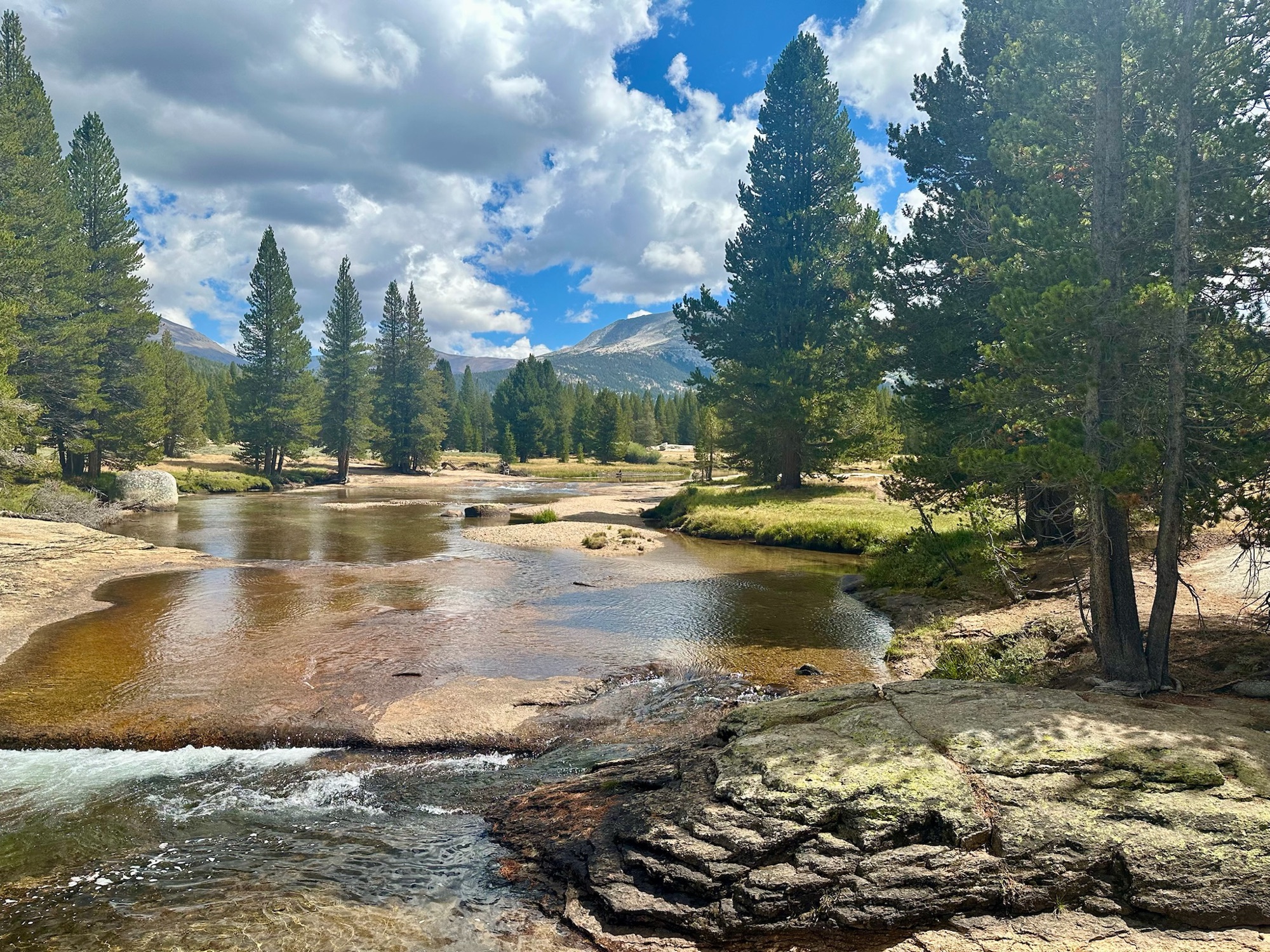
The Tioga Road lodges
The five High Sierra Camps have two close cousins you can drive to: Tuolumne Meadows Lodge and White Wolf Lodge. Same canvas tent cabins, same dining-tent suppers, same concessioner — reached by Tioga Road instead of a day on the trail. One is open in 2026; the other is closed by the same failing infrastructure that shut the camps.
See the five camps →Tuolumne Meadows Lodge
OpenOperating in 2026 — June 5 to September 13, conditions permitting
Sixty-nine tent cabins beside the Tuolumne River at 8,700 feet — the largest tent-cabin lodge in the high country, and the road-side gateway to the camp loop since the very first season in 1916.
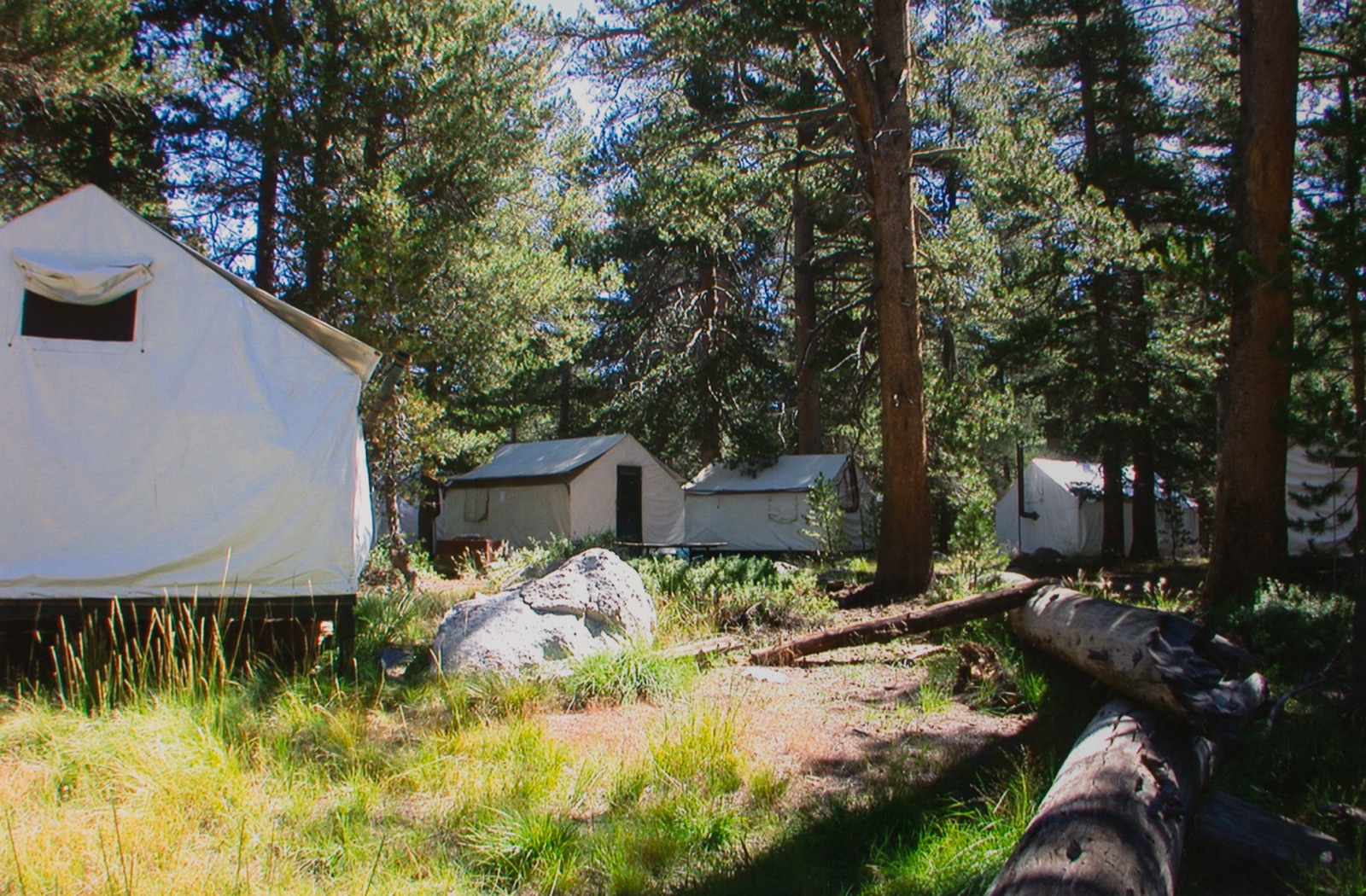
Tuolumne Meadows Lodge is where the High Sierra Camps' story touches the road. It began in 1916 as one of the Desmond Park Service Company's original permanent camps — the same first summer that built Merced Lake — and it was one of the seven stops in the revived chain of camps announced in 1924, each a day's walk apart. The five backcountry camps kept the walking; Tuolumne Meadows kept the road.
Its early years were not smooth. In May and June of 1916, mule teams carried lumber up to a site on the Dana Fork of the Tuolumne, where carpenters put up tents and a rock-and-canvas lodge; World War I closed it after only two summers. Reopened under new management in 1922 and folded into the Yosemite Park and Curry Company in 1925, it has operated every summer since — even through World War II — which makes it the one piece of the 1916 vision that has never gone dark.
Today it is the largest of the tent-cabin lodges: 69 canvas cabins in the trees by the Tuolumne River, with breakfast and dinner served in a riverside dining tent. There is no electricity in the cabins — the same candle-lit register as the camps proper — but you can park a car a short walk away. For generations of hikers it has been the first or last night of a camp loop; for everyone else, it is the easiest way to sleep in Yosemite's high country under canvas.
Unlike the five camps, the lodge is running in 2026 — open June 5 through September 13, conditions permitting.
The lodge also shares the meadow with the Tuolumne Meadows stable — the base whose mule strings still supply the backcountry camps.
White Wolf Lodge
ClosedClosed 2025; NPS-mandated closed for 2026 — damaged sewer lines
A meadow lodge at 8,000 feet off Tioga Road — 24 tent cabins, four wooden cabins, and a small dining room, held closed by the same kind of failing infrastructure that shut the camps.
White Wolf started as homestead ground along the old Tioga Road. The Meyer family finished converting it to a lodge in 1926 and added hard-sided cabins and tent platforms through the 1930s, each with a white wolf stenciled on the door. Its best season came in 1938, when the crews building the new Tioga Road that would bypass it filled the lodge; the war and the new road then drained its trade. In 1951 Wilson Meyer, the homesteader's grandson, sold the land and buildings to the National Park Service for $25,000, and it has been run by the park's concessioner ever since — rebuilt once already, after the record snows of February and March 1969 crushed the lodge and two cabins. Tucked in a quiet meadow about thirty miles from Yosemite Valley, it kept the small scale the camps share — 24 canvas tent cabins with wood stoves and no electricity, four prized wooden cabins, and a little dining room serving guests morning and evening.
And like the camps, it is a century-old outpost running on century-old utilities. White Wolf sat closed for the 2025 season, and the concessioner's own page now carries the plain sentence: the lodge "is mandated to remain closed by the National Park Service due to severely damaged sewer lines for the 2026 season." An NPS rehabilitation project for the lodge and its duplex cabins — foundations, plumbing, electrical, accessibility — has been on the books since a 2014 environmental assessment, with no reopening date announced.
Part of the same story
Road lodge or backcountry camp, these are the last places you can sleep under canvas in Yosemite's high country — and the same aging water and sewer systems threaten them all. Learn the camps' history, and help keep them open.