
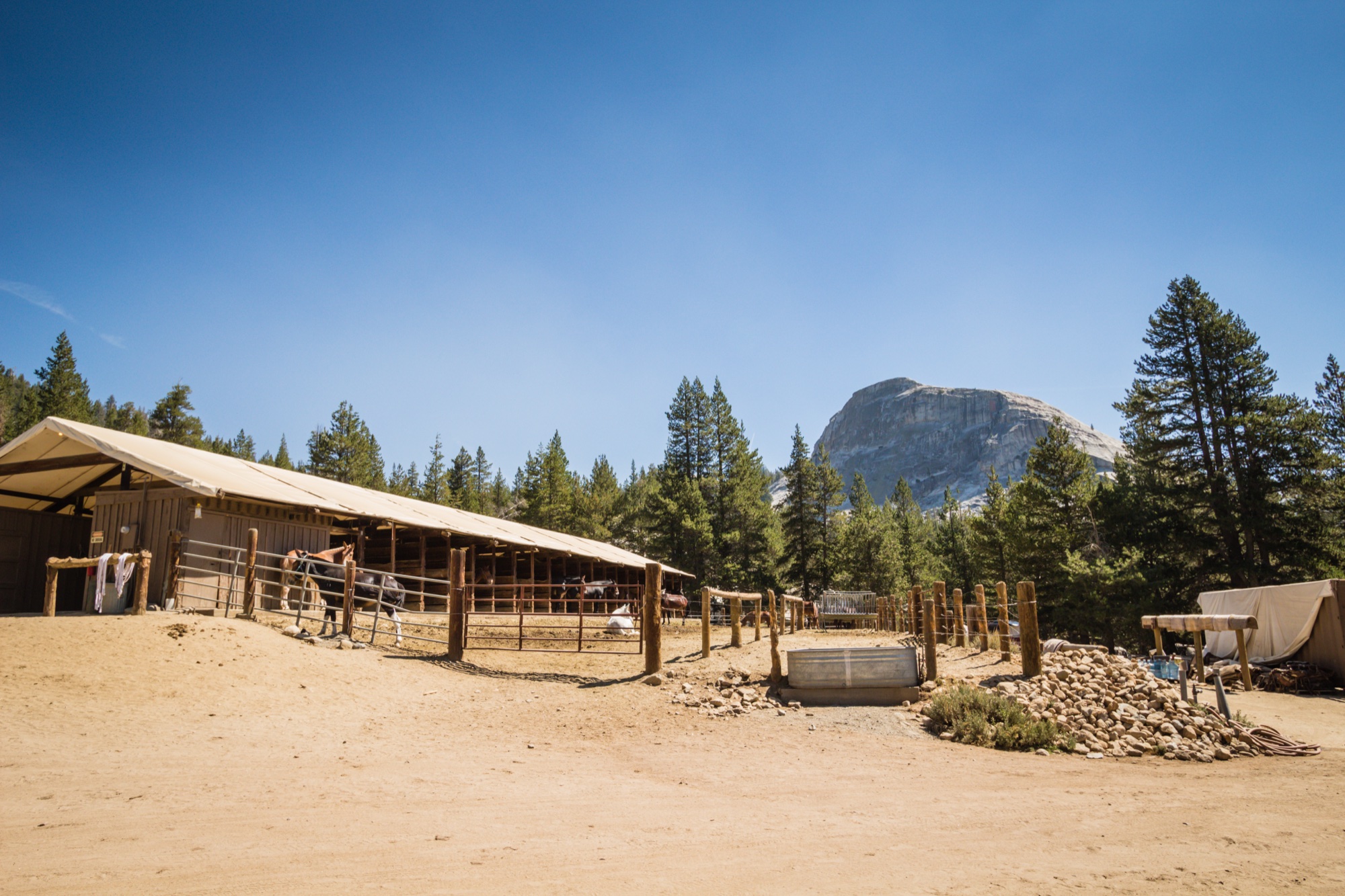
The stables
No High Sierra Camp has ever been reachable by road. Every bed, every meal, every propane bottle arrives on the back of a mule — and for a century, two stables kept the strings moving. One of them still does.
The camps run on mules
The five High Sierra Camps sit five to thirteen trail miles from the nearest road. That distance is the whole point of the camps — and it means the trail is the only supply line. The concession contract that governs the camps says it plainly: "Food must be delivered to the camps by pack stock." Menus at the camps are written, by contract, partly around the goal of minimizing the number of mule trips it takes to serve them.
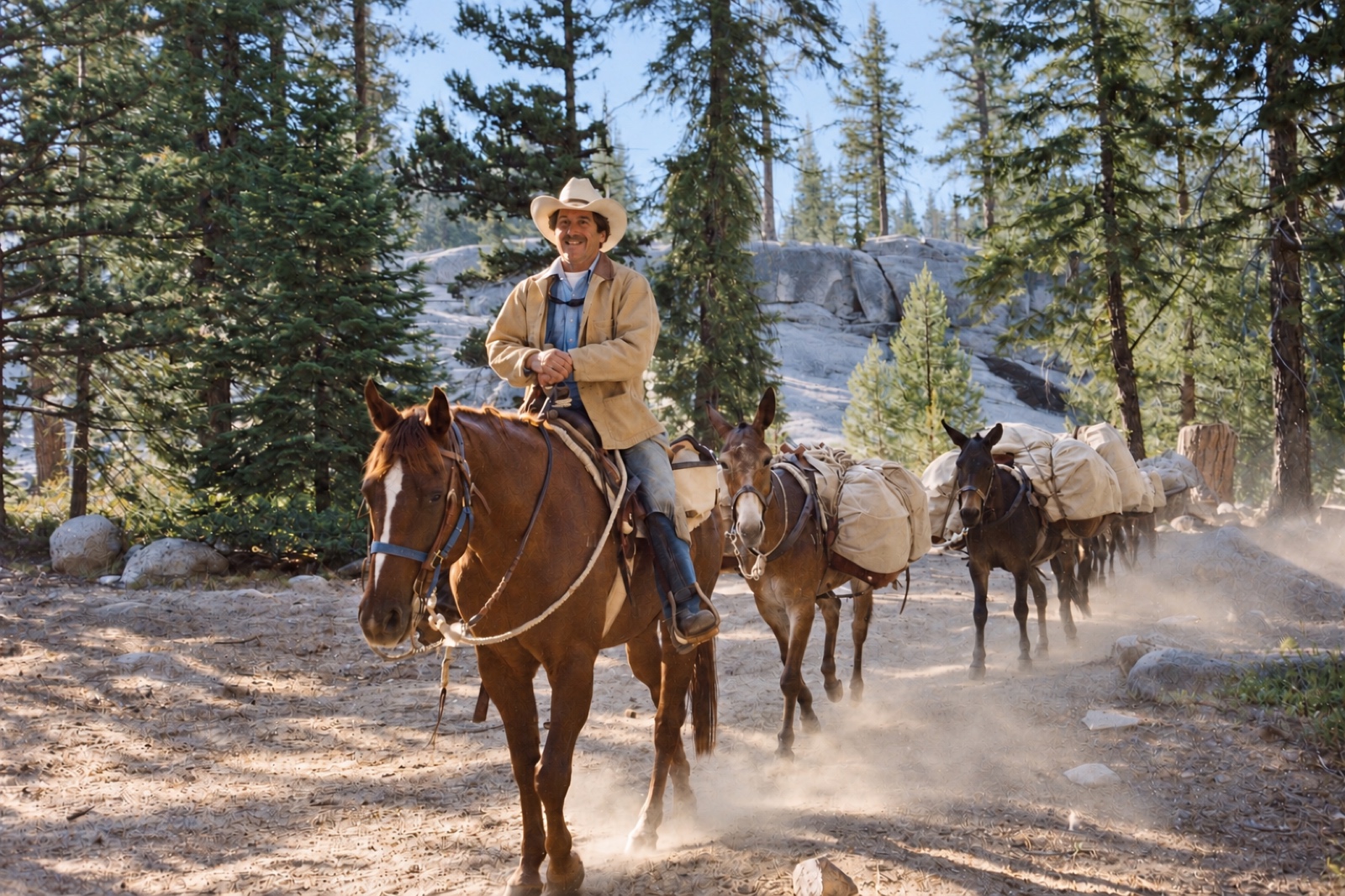
It was ever thus. In 1925, a newspaper profile of the young camp system marveled that Merced Lake Lodge was supplied "over seventeen miles of narrow and steep trails by mules." Sixty-five years later, Nic Fiore — who directed the camps for four decades — put it the way only he could: "The logistics are brutal. Everything must be hauled in and out by mule … We have probably the world's only mule-powered recycling program." In between, the camps' 1977 history put the rule in a single sentence: "All food, linen, mail, and other supplies are carried in on pack mules."
Behind that century of hauling stood two stables: one in Tuolumne Meadows, one on the floor of Yosemite Valley.
The Tuolumne Meadows stable
The stable at Tuolumne Meadows is the working heart of the system — in the words of the 2014 concession prospectus, "a stable used only for the resupply of High Sierra camps." From its barn and corrals near the Tioga Road, pack strings load and climb to Glen Aulin, May Lake, Sunrise, and — in the years they operated — Vogelsang and Merced Lake. It is also where the guided saddle trips around the camp loop have traditionally departed: four- and six-day rides, never more than fifteen riders including guides.
The rules the strings run under are written with the trails in mind. The contract's Horse and Mule Operating Plan caps supply trips to protect the busiest routes — Merced Lake at most seven and a half strings a week, Glen Aulin an average of five across the season. Feed must be certified weed-free so the mules don't seed invasive plants into the high country; grain is stored in bear-proof buildings; manure is cleared the same day from any trail within half a mile of a camp; strings travel single file, parties spaced fifteen minutes apart. The packers are camp-system employees — the contract does not allow the work to be farmed out to independent wranglers.
The Yosemite Valley Stables
The other half of the system stood near Curry Village, on a four-acre site whose buildings mostly dated to 1927: a 7,400-square-foot mule barn, saddle sheds, a tack room, a harness shop, a blacksmith shop. The Yosemite Valley Stables were Merced Lake's traditional supply base — the camp is thirteen trail miles up the Merced River canyon from the Valley, a different staging point than the four camps supplied from Tuolumne. And for park visitors, the Valley stables meant something simpler: two-hour and half-day trail rides, offered since the 1920s.
Those rides ended in 2015. Under the park's two river plans, the incoming concession contract eliminated public day rides at Tuolumne Meadows and in Yosemite Valley — summer 2015 was the last riding season in the meadows, that fall the last in the Valley, and the day rides moved to Wawona. Both stables stayed on with a single job: supplying the High Sierra Camps.
The Valley stables' story closed in February 2025, when Amendment No. 4 to the concession contract — the same amendment that removed Merced Lake and Vogelsang — removed Yosemite Valley horse-and-mule operations and the stables property from the contract, citing the cost of the deferred maintenance the old buildings carried. Under the amended contract, horse-and-mule operations continue at Tuolumne and Wawona.
The mules still run
In season, strings still load at Tuolumne Meadows and climb to the three camps operating on today's loop — Glen Aulin, May Lake, and Sunrise. A pack tradition as old as the camps themselves is still a working system, not a museum piece. It stays that way exactly as long as the camps do: keeping the High Sierra Camps open keeps the mules on the trail.
Part of a larger story
The stables are the supply chain of a century-old system — five camps, a day's walk apart, that made Yosemite's high country open to anyone on foot. Read the full history or meet the five camps.