Yosemite High Sierra Camps

A century in the high country

The High Sierra Camps were built on a simple, radical idea: that the backcountry should be within reach of ordinary people — a bed and a hot meal a day's walk apart. This is how the system grew, and how it came to shrink.

From the archives: the founding decade in the day's newspapers

In 1916, the year the National Park Service was created, its first director Stephen Mather set out to prove that wilderness and public access could go together. His answer was a network of modest tent-cabin camps deep in Yosemite's high country — close enough to walk between, comfortable enough that you needed to carry only a daypack.

Merced Lake led the way alone for a full decade. In 1923 Yosemite's first Park Service superintendent, W. B. Lewis, set out to revive the camp idea, and sent the park's young naturalist, Carl P. Russell, to walk the backcountry and choose where the camps should stand — picking sites for their beauty, their water, and their spacing a day's walk apart. Then, on July 10, 1926, the pieces came together: with the Tenaya Lake and Boothe Lake camps opening, a newspaper dispatch from the park could report "the complete circuit of five High Sierra camps" in operation for the first time. That was one hundred years ago this summer — the centennial of the loop itself.

The sites shifted over the decades that followed, and the system settled into the five camps of the modern era — Merced Lake, Vogelsang, Glen Aulin, May Lake, and Sunrise — strung along a 51-mile loop. Much of that settling was the work of the camps' operator family: Donald and Mary Curry Tresidder of the Yosemite Park & Curry Co. sited May Lake together in 1938, and Mary, as the company's president, added Sunrise in 1961 — the last camp, completing today's five. For generations they introduced hikers, families, and schoolchildren to the Sierra, and many of those visitors became lifelong advocates for the parks.

If Mather was the system's architect, Nic Fiore was its human face. From 1963 to 2004 the French-Canadian ski instructor directed all five camps every summer — more than four decades as host and manager, greeting guests, running the camps' famous evenings, and thinking nothing of hiking between two or three camps in a single day. For a generation of backcountry travelers, he simply was the High Sierra Camps, proof that a place like this is held together as much by people as by tent-cabins.

A system under strain

The last decade has been harder. Record snowpack, deferred maintenance, a shrinking pack-stock system, a global pandemic, and sustained budget pressure on the National Park Service have combined to close camps for years at a time. Two of the five — Merced Lake and Vogelsang — have now sat closed for the better part of a decade, with no announced plan to reopen them.

Three camps operate again in 2026 — the circuit's centennial year. But a three-camp loop is not the system Mather built, and the quiet loss of the other two is exactly the kind of attrition that is easy to ignore until it is permanent. A hundred years after the first hikers walked the complete circuit, the camps still standing are worth protecting — and the ones that have gone dark are worth bringing back.

From the archives

The founding decade, as California's newspapers reported it. These four articles ran between 1916 and 1926 and are in the public domain; each card links to the original scan in the California Digital Newspaper Collection.

Merced County Sun masthead, September 29, 1916

Merced County Sun · September 29, 1916

A trail to Waterwheel Falls, a telephone line to Merced Lake

A dispatch from Merced Lake camp's founding season. Before anything else, the park built the camp's infrastructure — including a telephone line down to Yosemite Valley.
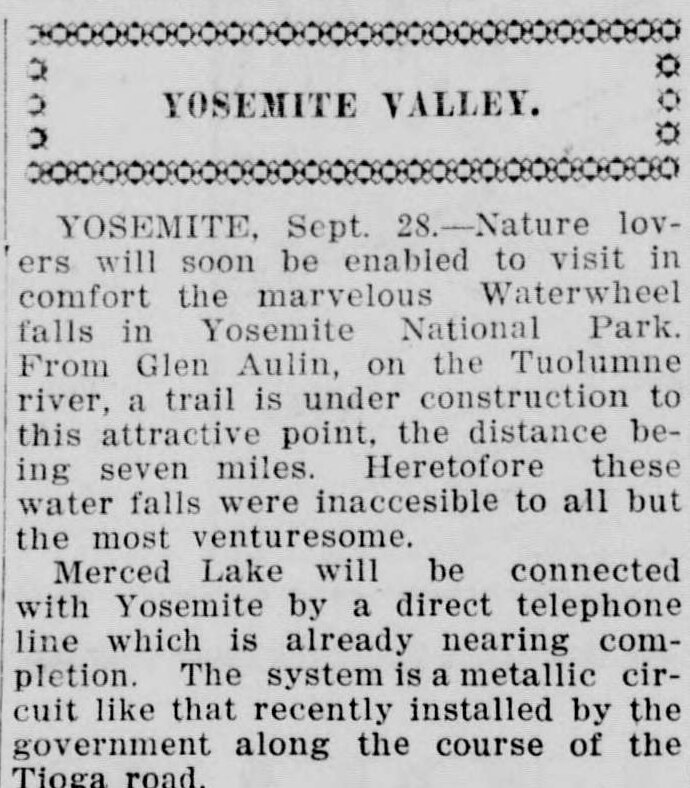
Newspaper clipping: Merced County Sun, September 29, 1916
The clipping as printed — view full size

YOSEMITE, Sept. 28 — Nature lovers will soon be enabled to visit in comfort the marvelous Waterwheel falls in Yosemite National Park. From Glen Aulin, on the Tuolumne river, a trail is under construction to this attractive point, the distance being seven miles. Heretofore these water falls were inaccessible to all but the most venturesome.

Merced Lake will be connected with Yosemite by a direct telephone line which is already nearing completion. The system is a metallic circuit like that recently installed by the government along the course of the Tioga road.

Read the original scan
Daily News Leader, San Mateo masthead, February 13, 1924

Daily News Leader, San Mateo · February 13, 1924

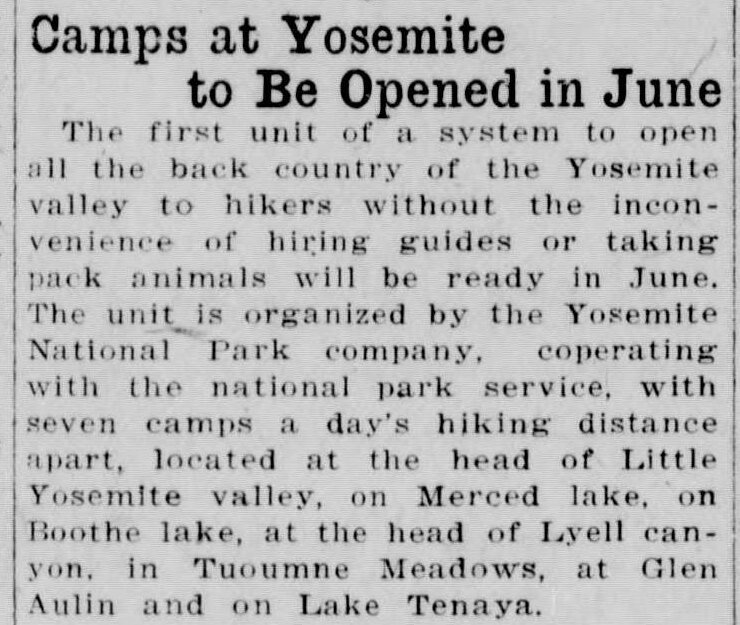
“Camps at Yosemite to Be Opened in June”

The earliest known announcement of the High Sierra Camps as a system: seven camps a day’s hike apart, and the founding promise of a backcountry open to anyone on foot. The complete article:

Newspaper clipping: Daily News Leader, San Mateo, February 13, 1924
The clipping as printed — view full size

The first unit of a system to open all the back country of the Yosemite valley to hikers without the inconvenience of hiring guides or taking pack animals will be ready in June. The unit is organized by the Yosemite National Park company, cooperating with the national park service, with seven camps a day’s hiking distance apart, located at the head of Little Yosemite valley, on Merced lake, on Boothe lake, at the head of Lyell canyon, in Tuolumne Meadows, at Glen Aulin and on Lake Tenaya.

Read the original scan
Madera Mercury masthead, August 15, 1925

Madera Mercury · August 15, 1925

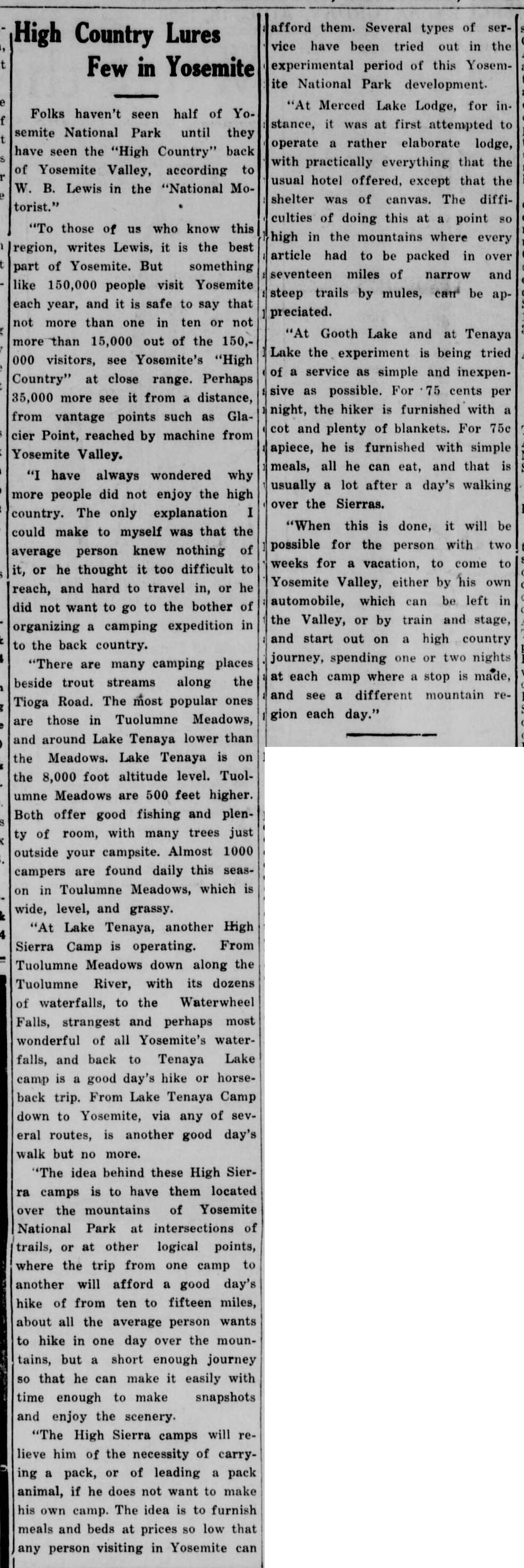
“High Country Lures Few in Yosemite”

W. B. Lewis, Yosemite’s first National Park Service superintendent, explains in his own words what the camps are for.

Newspaper clipping: Madera Mercury, August 15, 1925
The clipping as printed — view full size

“Something like 150,000 people visit Yosemite each year, and it is safe to say that not more than one in ten, or not more than 15,000 out of the 150,000 visitors, see Yosemite’s ‘High Country’ at close range.

“The idea behind these High Sierra camps is to have them located over the mountains of Yosemite National Park at intersections of trails, or at other logical points, where the trip from one camp to another will afford a good day’s hike of from ten to fifteen miles, about all the average person wants to hike in one day over the mountains, but a short enough journey so that he can make it easily with time enough to make snapshots and enjoy the scenery.

“The High Sierra camps will relieve him of the necessity of carrying a pack, or of leading a pack animal, if he does not want to make his own camp. The idea is to furnish meals and beds at prices so low that any person visiting in Yosemite can afford them.

“For 75 cents per night, the hiker is furnished with a cot and plenty of blankets. For 75 cents apiece, he is furnished with simple meals, all he can eat, and that is usually a lot after a day’s walking over the Sierras.”

Read the original scan
San Pedro Daily News masthead, July 29, 1926

San Pedro Daily News · July 29, 1926

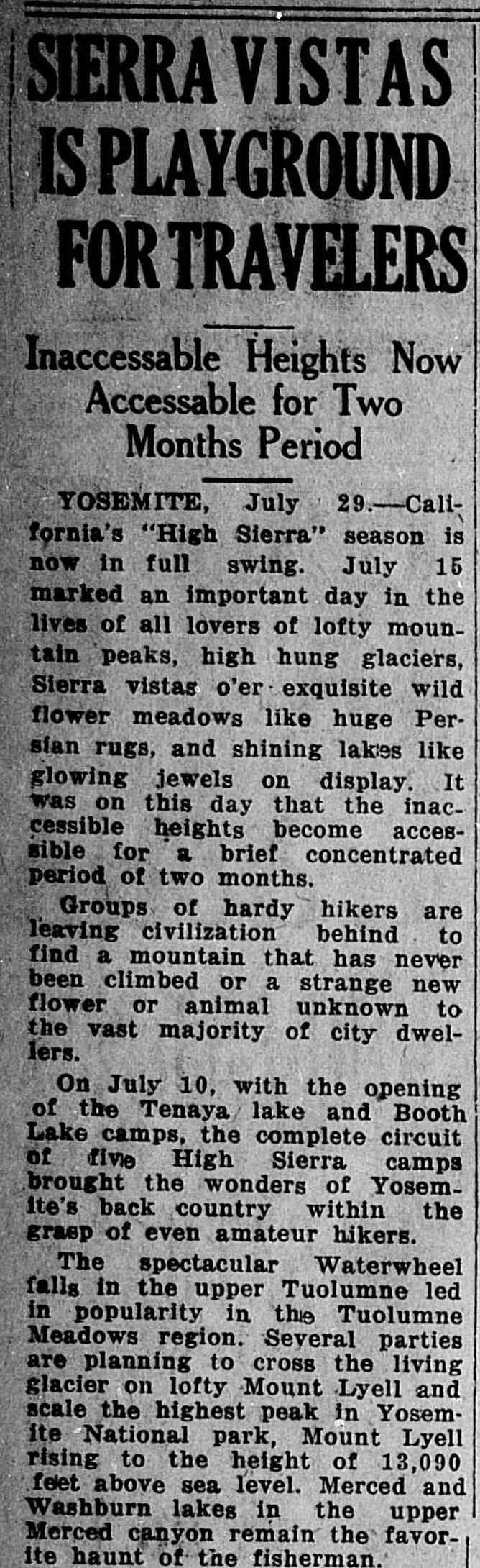
“Sierra Vistas Is Playground for Travelers”

The original five-camp circuit, complete and in operation — under the period subhead “Inaccessable Heights Now Accessable for Two Months Period.”

Newspaper clipping: San Pedro Daily News, July 29, 1926
The clipping as printed — view full size

YOSEMITE, July 29 — California’s “High Sierra” season is now in full swing. July 15 marked an important day in the lives of all lovers of lofty mountain peaks, high hung glaciers, Sierra vistas o’er exquisite wild flower meadows like huge Persian rugs, and shining lakes like glowing jewels on display. It was on this day that the inaccessible heights become accessible for a brief concentrated period of two months.

On July 10, with the opening of the Tenaya lake and Boothe Lake camps, the complete circuit of five High Sierra camps brought the wonders of Yosemite’s back country within the grasp of even amateur hikers. The spectacular Waterwheel falls in the upper Tuolumne led in popularity in the Tuolumne Meadows region. Several parties are planning to cross the living glacier on lofty Mount Lyell and scale the highest peak in Yosemite National park, Mount Lyell rising to the height of 13,090 feet above sea level. Merced and Washburn lakes in the upper Merced canyon remain the favorite haunt of the fisherman.

Read the original scan

Transcriptions are lightly cleaned of scanning (OCR) errors; the papers' own period spellings are kept as printed. Scans courtesy of the California Digital Newspaper Collection, UC Riverside.