
W. B. Lewis
1884–1930Yosemite's first National Park Service superintendent — the engineer who ran the park for twelve years, revived the High Sierra Camps in 1923, and left his name on the creek the camp loop still climbs.
If Stephen Mather imagined the High Sierra Camps and Carl P. Russell chose their ground, Washington B. "Dusty" Lewis is the man who made the system happen. As Yosemite's first civilian superintendent under the brand-new National Park Service, he was Mather's man on the ground for twelve years — and the camps that opened across the high country in the 1920s were, in the most practical sense, his doing.
Mather's man on the ground
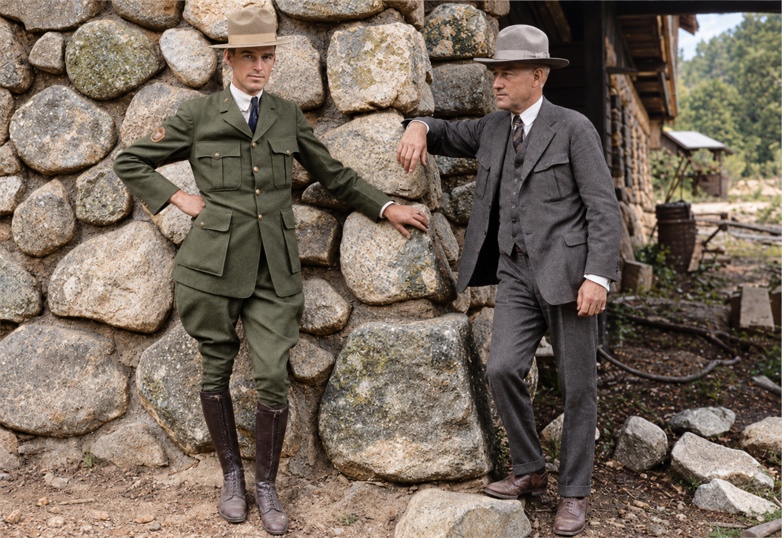
Lewis was an engineer before he was a park man. A topographer with the U.S. Geological Survey, he had surveyed coal lands in Wyoming, mapped Alaska with the first National Geographic Society expeditions of 1909, and run exploratory surveys in Patagonia before arriving in Yosemite from Washington, D.C. in March 1916 — the same year Congress created the National Park Service. The park's own commissioned history calls him "one of the most popular superintendents in national-park history. A good engineer . . . he was exactly what Mather wanted for Yosemite." Always immaculate in uniform, superintendent's brassard on his sleeve, he spent twelve years guiding into place much of the modern park — its roads and trails, its first power plant, the opening of Hetch Hetchy to visitors, the first marking of the park's historic sites.
1923: reviving the camps
The first backcountry camps of 1916 had folded with their bankrupt concessionaire. In 1923 Lewis advocated re-establishing the High Sierra camping service — "simple, cheap accommodations at minimum operating expense" — and sent his new park naturalist, Carl P. Russell, into the backcountry to choose where the camps should stand. Most were built the very next season; by 1925 they carried the High Sierra name, and by July 1926 the five-camp circuit was complete. When the rivalry between the park's two concession companies threatened the whole enterprise, Lewis — with Mather, Horace Albright, and the Secretary of the Interior — pushed through the 1925 merger that created the Yosemite Park & Curry Co., the operator that would run the camps for the next 68 years.
What the camps are for, in his own words
Lewis also left the clearest founding statement of the camps' purpose we have. Writing in the National Motorist in 1925, he laid out the design: camps at trail intersections "where the trip from one camp to another will afford a good day's hike of from ten to fifteen miles"; a cot and plenty of blankets for 75 cents; "meals and beds at prices so low that any person visiting in Yosemite can afford them." Only one visitor in ten, he noted, ever saw Yosemite's high country at close range — the camps were his answer. The full article is on the history page's archive section, from the newspapers that reprinted it that summer.
An early end, and a name on the land
A heart attack in the fall of 1927 forced Lewis to give up the superintendency in mid-1928. He recovered enough to serve as Assistant Director of the National Park Service under Mather, then died at his home in Chevy Chase, Maryland on August 28, 1930 — just 46, outliving Mather by only seven months. Yosemite wrote his name onto the map: the new park hospital, dedicated the year he died, became Lewis Memorial Hospital; Mount Lewis rises near Tioga Pass; and the Merced fork that hikers climb from Merced Lake toward Vogelsang has been Lewis Creek since 1944. Every camp-to-camp day along that stretch of the loop walks through the name of the superintendent who made the loop exist.